Recent News

Breathing Fire

The late great physicist Stephen Hawking once speculated that, besides the mathematical equations he and others had developed about the nature of the universe, something was needed to “breathe fire” into them – i.e., make them a reality. Reading through Pope Francis’ latest encyclical, Fratelli Tutti, released just this weekend, you can’t help feeling that it, too, is seeking some concrete, creative fire.

If I were a Catholic progressive, and someone asked me what to read to understand where the Church stands today, however, this wouldn’t be the text I would press into his hands. And it has nothing to do with liberal or conservative. With all due respect to the Holy Father, it’s all but unreadable. Only those of us who love the Church and are loyal to the pope will get through it, from duty, not intellectual or spiritual interest. And that’s a serious shortcoming for a text addressed not only to Catholics but all people of good will.
It would be surprising if it does not produce disappointment among Catholic progressives, who have been expecting something big. Their favorite policies are here – and the media will push them as something fresh. But such sparks as are struck are buried under mountains of repetition, conceptual vagueness, and utopian aspirations.

Recent papal documents are not exactly known for succinctness – St. John Paul II often went on a lot longer than he should. And there’s a kind of inside-Church-speak that enters into all of them. But usually they have some central stabilizing clarity. Here, it’s universal human brotherhood – “fraternity and social friendship” in the title – which is anything but clear even after nearly 200 pages.

Click here to read the rest of Professor Royal’s column at The Catholic Thing . . .

Blue and Black

Do you know about G.K. Chesterton’s example of the blue world? He writes in Orthodoxy of a reformer whose passion is to make the world blue – not in the sense of unhappy, mind you, but actually the color blue.

“He could have heroic adventures,” GKC writes, “the putting of the last touches to a blue tiger. He could have fairy dreams; the dawn of a blue moon. But if he worked hard, that high-minded reformer would certainly (from his own point of view) leave the world better and bluer than he found it.” It’s a silly example of reforming, he admits, but therefore simple to grasp.

However, “if he altered his favourite colour every day, he would not get on at all. . .there would be nothing to show except a few blue tigers walking about.”

Chesterton’s famous summary is this:

So it does not matter (comparatively speaking) how often humanity fails to imitate its ideal; for then all its old failures are fruitful. But it does frightfully matter how often humanity changes its ideal; for then all its failures are fruitless.

Click here to read the rest of Mr. Miner’s column at The Catholic Thing . . . 

Lying for Justice?

Some years ago, a friend told me about how he’d chosen the title of his book, which was about to appear. He wasn’t primarily a writer. He’d long worked with the homeless in San Francisco – until he saw what was really going on. He went to bed one night, praying to come up with a title, which had been elusive. He woke with what he knew was exactly right: Lying for Justice.

His book argued that social justice activists claimed people were homeless because of capitalism, racism, sexism, etc. Then, as now, those were sometimes factors. But by far, the homeless suffered from psychological problems, drug and alcohol abuse, and – most commonly – family breakdown.

SF policies, intended to remove the stigma from homeless people and open public spaces to them, only made things worse, inviting hordes onto the city’s streets – a phenomenon that has worsened, and spread to Los Angeles, New York, Washington, recently even Rome.

Our unwillingness to see and act on hard truths has become something of an epidemic. Many homeless, sadly, need vigorous intervention, even institutionalization, for their own good.

Click here to read the rest of Professor Royal’s column at The Catholic Thing . . .
Our Labor Today

Labor Day is not a happy holiday this year in America. There’s still much to be grateful for, very grateful, in our big, bountiful, awe-inspiring, sprawling, contentious, exasperating, but still heart-swelling nation. Our labor, our greatest task now is different than in the past. We still, of course, face old, perennial questions about how to enable more of us to participate in the blessings of liberty. But we must all now work with purer intent to preserve and protect the very things that make those blessings possible.

Communities, like individual human lives, are imperfect, vulnerable, easy to break down, harder to build up. As we’ve seen recently, a few malefactors can destroy large swaths of great modern cities in just a single night of arson, looting, and riots. Repairing the material destruction – as we learned after similar events in the 1960s – can take years, and the moral and spiritual damage longer, if ever.

What does the conscientious citizen, especially the Catholic citizen, do in such circumstances? There are policies to fight for, via law, politics, and media. More importantly, though, Catholics bring a different perspective to problems – or should.

We know God is the only real Lord of the world and his main instruments are truth and justice, but also mercy, forgiveness, bearing one another’s burdens, knowledge – contrary to utopians of various persuasions – that all have sinned, and a commitment to living and working in mutual solidarity despite our many and deep imperfections.

Click here to read the rest of Professor Royal’s column at The Catholic Thing . . .

“FATIMA”: a Review

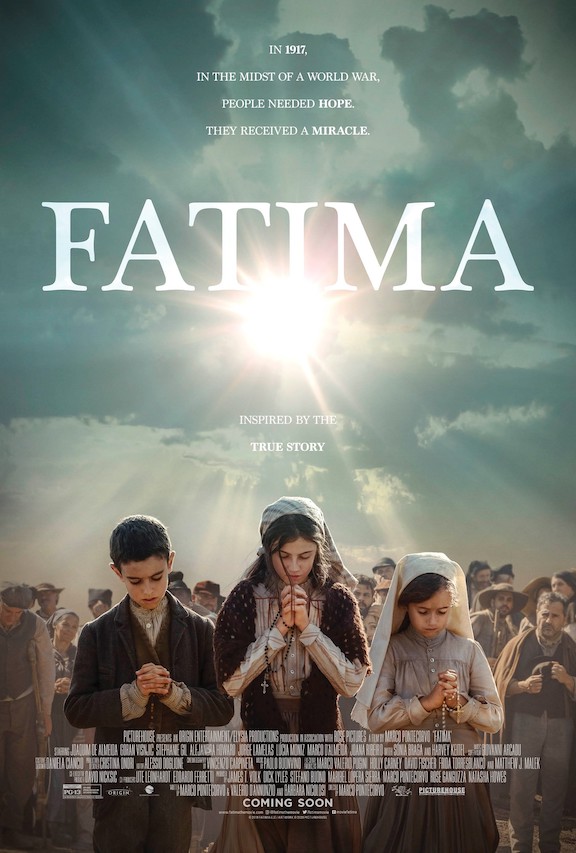
The time has probably passed when films about faithful Catholics could be box-office hits, but Italian director Marco Pontecorvo has given his best to make one with Fatima.

This iteration of the story of the Marian apparitions scans almost as a remake of 1952’s The Miracle of Our Lady of Fatima, except for a flash-forward device involving a purported interview of the now elderly Sister Lúcia dos Santos by a noted journalist. The two are played by Brazilian actress Sônia Braga and the American Harvey Keitel: the saint and the skeptic.

It’s not a bad idea exactly, although their periodic exchanges, happening in the “present,” tend towards didacticism and do nothing to affect our sense of events in Portugal in 1917.

Those events, on the other hand, are beautifully shown in Fatima. Mr. Pontecorvo, who began his career as a cinematographer, has here collaborated with cameraman Vincenzo Carpineta to give us a very vivid Aljustrel, Lúcia’s hometown just outside of Fátima. (The film was shot entirely in Portugal.)

Click here to read the rest of Mr. Miner’s column at The Catholic Thing . . .
How It All Ends

So many things seem to be on the fast train to hell at the moment that it came into my head to look into the Apocalypse. Not some “apocalyptic” film or novel – the Apocalypse, the Book of Revelation, the last book of the New Testament and, therefore, the conclusion of Holy Scripture.

It’s understandable that people don’t pay much attention to the Apocalypse. Most of us vaguely know that it says someday it’s all going to break bad, cosmically bad. Who wants to think about that?

Despite being God’s last written communication to us, for a casual reader, it’s a strange text, not easy to take in. Some of the more overheated evangelicals relish its wilder side, and “the Rapture” too, of course, and much else that can’t help making a sober Catholic wary.

But that’s far from being the whole story of the Apocalypse. I’ve often disagreed with public stances of South Africa’s Anglican Bishop Desmond Tutu. He’s absolutely right, though, in what he’s said about Revelation: “I’ve read the end of the book. . . .We win.” More accurately, God wins, but if you think you’re in – or at least hope someday to be in – His fold, it comes to much the same thing.

Terrible events are symbolically foreshadowed before this world ends in the Apocalypse, even more terrible than COVID-19, rioting, and presidential elections. If you think we have it rough now, look at the deadly plagues, rampaging Beast, the cosmic Dragon, and Satanic assaults that Scripture talks about as it wraps up. It makes Tolkien look like an amateur.

Click here to read the rest of Bob Royal’s column at The Catholic Thing . . .
Portable Hell: “Words on Bathroom Walls”

“The mind,” wrote John Milton in Paradise Lost, “is its own place, and in itself can make a heaven of hell, a hell of heaven.” Perhaps nobody knows that better than people suffering from schizophrenia.

Schizophrenia has been a popular subject for books – and for films based upon those books – and often good for an actor portraying the person suffering from the disorder. To cite just three such films: The Snake Pit (1948), Anatole Litvak’s version of a true story, starring Olivia de Havilland in an Academy Award-nominated performance; Ingmar Bergman’s Through a Glass Darkly (1961 – an original story), which won the Oscar for Best Foreign Film and wide acclaim for Harriet Andersson’s performance; and A Beautiful Mind (2001), Ron Howard’s Best Picture winner at the Oscars for which Russell Crowe received a Best Actor nomination. There are dozens of other films, many more if violence is brought into the picture. Your typical movie slasher is “schizoid.”

Most schizophrenics, of course, are not violent. Nearly all hear voices, and some experience visual hallucinations as well. Such is the case with Adam, a teenager in Thor Freudenthal’s compelling new movie Words on Bathroom Walls.

Psychiatrists and other healthcare professionals often express dismay, as well they should, at the way schizophrenia is portrayed on screen. Because Words on Bathroom Walls is just out, I’ve come across no such criticism of it, although I suspect there will be, principally because the voices Adam hears are visually manifest as people in the film.


Click here to read the rest of Mr. Miner’s review at The Catholic Thing . . .

The Politics of Heaven and Hell

Shortly after I arrived in Washington years ago, I reviewed a book with the same title as this column. A friend warned about reviewing books by that particular author – our late lamented colleague James V. Schall, S.J. – because if you start, he said, you won’t have time for anything else. And that was before the supernova of titles that Schall the Great turned out in his seventies, eighties, and even nineties.

Ignatius Press is republishing The Politics of Heaven and Hell this fall with an introduction by another incisive and prolific writer, Robert Reilly. A good thing, too, because in our current chaos, when it seems almost impossible to get sure footing about anything, this relatively neglected volume not only uncovers sure foundations. It explains the ways by which we’ve mixed up eternal and temporal things – and put the times out of joint.

Schall’s central insight is that our classic traditions of both faith and reason agree that politics is an important, but circumscribed realm. If we were the highest beings, politics would be the highest science, said Aristotle. That wise pagan – Dante calls him “the master of those who know” – knew that we are not the highest beings. There’s God, for starters, and His Creation, to which we owe deference. Ignore them, and the inevitable result is chaos, suffering, servitude, tyranny, and death.

The ancient Hebrews learned this well before Aristotle. Schall notes how little attention political theorists pay to the Old Testament, the history of a small and obscure nation – Israel – that survived, improbably, down to our own time, with incalculable influence on the history of the whole world. It did so not because of any special policies or virtues: Jewish history is a record of graces given and refused, of return and consequent flourishing, of many rounds of ignoring God, decline, and renewal through Him.

Click here to read the rest of Bob Royal’s column at The Catholic Thing . . .

Things Always Fall Apart

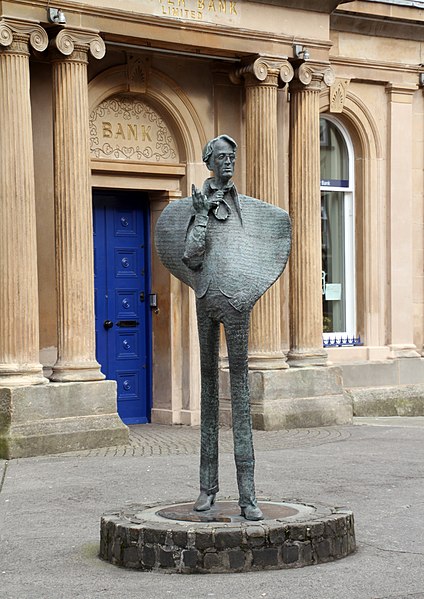
I’m tempted to begin a campaign to knock down the statue of William Butler Yeats that’s outside the Ulster Bank near his boyhood home, and the good people of Sligo would probably thank me, because Ronan Gillespie’s statue is hideous.

But I’m no iconoclast. And – love him or hate him – a poet of Yeats’ stature deserves a statue. Here are two reasons why.

First, there’s his life. William Butler Yeats was born on the south side of Dublin, Ireland in 1865. Early on, the family moved, and he grew up in Slough (in South Central England) and later in London. Then his family moved back to Dublin in 1880.

His return to Ireland propelled him into all things Irish – all things, that is, except the Catholic Church.

In William’s early twenties, the Yeats family moved back to London – patriarch J.B. Yeats was nothing if not peripatetic. W.B. joined a poets’ group, the Rhymers’ Club, became interested in spiritualism and joined a group called The Ghost Club. He took an interest in fairies.

Click here to read the rest of Mr. Miner’s column at The Catholic Thing . . .

The Veil

Sometimes you start thinking (or even writing) about something, and it suddenly becomes more complicated than you initially imagined. Ideas tumble; you hope not uncontrollably.

The Veil of Veronica is such a case for me.

As a convert to Catholicism – one whose growth in the faith has come in fits and starts over 43 years – I’ve been both attracted to and repelled by relics. I’ve a bit of the attitude, I suppose, of the Catholic humanist Erasmus of Rotterdam (d. 1536), who wrote of fragments of the True Cross that “if all. . .were collected together, they would appear to form a fair cargo for a merchant ship.” Mind you, Erasmus believed in Christ and probably assumed some of the wooden shards encased in altars or displayed under glass in churches and cathedrals were authentic; he simply doubted that all of them were.

But I’m not a skeptic. For instance, I’ve come to believe the Shroud of Turin is exactly what it’s claimed to be. In the matter of the Veil of Veronica, however, I’m not so sure.

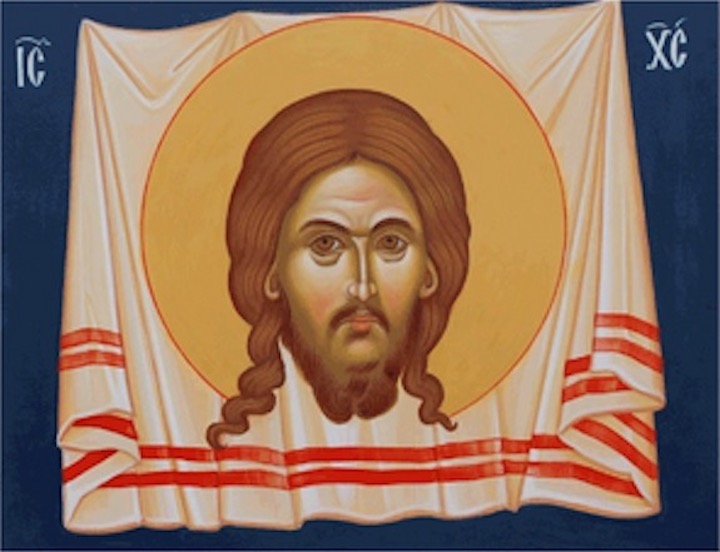
Who was this Veronica? Well, she is alleged to have been an early Christian woman, one among those along the Via Dolorosa on Good Friday. She knelt to press a towel or cloth (velum in Latin, thus our English word “veil”) to the face of our suffering Savior when He fell beneath the weight of the Cross.

Her name, however, is unlikely to have been Veronica, because that is a portmanteau word formed from the Latin vera, meaning truth, and the Greek eikon, meaning image, which is to say this woman was the bearer of the True Image, the Real Icon, the Veronica.

Click here to read the rest of Mr. Miner’s column at The Catholic Thing . . .